To all those who are current, future, or past members of our armed forces, I want to extend my most sincere "thank you."
As the grandson of a World War II Iwo Jima veteran, I have grown up knowing the true importance of those who have laid their lives on the line for me to have freedoms such as the chance to communicate openly with all of you online however I wish. All day we have seen things across Facebook and Twitter, of people expressing their appreciation for our servicemen and women. It takes days like this for many to realize how great they really have it.
In America today, we often seem to forget that we have one of the best qualities of life in the entire world. This did not come without a cost. They fought at Gettysburg, Bull Run, Montezuma, Normandy, Germany, Korea, Vietnam, Iraq, Afghanistan, and many more. Why do they fight? Well, they fight not because they hate what's in front of them, but for the preservation of what they left behind. Soldiers don't fight for a president, senators, of corporations. Soldiers fight for every single one of us, and for the freedom with which we get the pleasure of living. People in many other countries will never have the chance to experience this. I hope everyone took a minute to say thank you to someone serving our nation at home or abroad, or to pat themselves on the back if they served or are serving themselves. To quote the Facebook and Twitter-famous "Earl Dibbles Junior," "Heroes don't have their name on the back of a jersey. They have their country's flag on the arm of their uniform." I feel that this is a very truthful statement, and one we should remember.
Happy Veteran's Day to all! Tonight with Purdue Collegiate FFA, we wrote over 60 thank you cards that we are taking to an ice cream social tomorrow at a veteran's home in Lafayette. It is an honor to me to be able to do something like this for people that did so much to preserve our nation's beliefs, values, and freedoms.
God Bless America, Our Veterans, And You.
Link up to other "30 Days" bloggers here.
Monday, November 11, 2013

Day 10: Self Renewal, Coming Home
I feel like most people will go through times in their lives where they feel they are in a rut, or can't get things to work. Professionals in "calming down" will always say you need to find an outlet or an escape. Well, what is a college student to do when they're struggling through the week? I recommend seriously that you find something that makes you happy (but isn't going to get you arrested) and try to find some time to work this into your schedule.
I have had weeks where I had to muddle through classes, tests, and the "struggle" of life away from family and my best friends that have been with me for the last decade and a half of my life. This weekend in Kansas City was a chance for me to, "refresh, recharge, and restart." What do I mean by this? Well, being surrounded by people with similar passion to me, and in an environment where energy was higher than the national debt. This type of situation works for some people.
My solution for putting everything back in line often happens when I go home. Something about Dubois County makes me a happy person in general! I never realized as a child what my community meant to me until I left. This is why I find it interesting that everyone grows up with the stigma of, "I'm leaving this Podunk town and never coming back! Mark my words!" But in reality, who comes back? Many of them. Why do we do this is a better question. If you haven't noticed, I live life asking questions. I feel it is important to question nearly everything. Don't let questioning ruin life (it can happen to some), but use it as an educational tool.
We return home for many reasons, I believe. You may move to Nashville, New York, Indianapolis, Chicago, or somewhere else after college, and as a young person, sure it's nice. It is the point when individuals look at settling down and raising a family that they truly look at what your parents offered you growing up. I will personally say that small-town living made me who I am. Here in Lafayette, I go to a restaurant, gas station, or store and most of the time do not know anyone. At home, I stop nearly everywhere I go because I have run into someone I know. On any given day it may be a teacher, family friend, the mayor, my priest, or any other variety of people. In a smaller community there is a smaller network of people and therefore your network overlaps that of many others, making you closer to nearly everyone.
I'll proudly say that I want to let my children grow up in a community that is close, just like I could. When I walk into church, I know a large percentage of the people in the service. I go to the grocery and know 3/4 of the people working. My mayor and I are on a first name basis. Things like this do not just "happen" in large cities. I love the song, "Everybody Dies Famous in a Small Town." I think it may be a Miranda Lambert song? It describes life so well. This is how I felt when I sat at ISSMA State Marching Band Finals in Lucas Oil Stadium two weeks ago. DeKalb High School did a show called "We Are DeKalb." The music and show was built around the idea that, small towns are a different world. We can be close, connected, and united. Unity is important, and I feel it is vital in maintaining a high level of morals and proper behavior in today's young people.
If you're ever feeling down, take a trip back home. This works wonders for me! I wish I could attach a photo, but I have never stopped to take a one. There is a sign on the north side of my hometown that says, "Welcome to Jasper, if you lived here, you'd be home now!" Passing that sign and coming up on Home Depot and Applebee's is where I get that feeling deep down of, "I'm home. It's alright."
To sway any concerns, I'm doing fine, and I just wanted to do a short piece on self renewal and coming home. It is something unique to every individual, but something shared all the same.
Link up to other "30 Days" bloggers here.
I have had weeks where I had to muddle through classes, tests, and the "struggle" of life away from family and my best friends that have been with me for the last decade and a half of my life. This weekend in Kansas City was a chance for me to, "refresh, recharge, and restart." What do I mean by this? Well, being surrounded by people with similar passion to me, and in an environment where energy was higher than the national debt. This type of situation works for some people.
My solution for putting everything back in line often happens when I go home. Something about Dubois County makes me a happy person in general! I never realized as a child what my community meant to me until I left. This is why I find it interesting that everyone grows up with the stigma of, "I'm leaving this Podunk town and never coming back! Mark my words!" But in reality, who comes back? Many of them. Why do we do this is a better question. If you haven't noticed, I live life asking questions. I feel it is important to question nearly everything. Don't let questioning ruin life (it can happen to some), but use it as an educational tool.
We return home for many reasons, I believe. You may move to Nashville, New York, Indianapolis, Chicago, or somewhere else after college, and as a young person, sure it's nice. It is the point when individuals look at settling down and raising a family that they truly look at what your parents offered you growing up. I will personally say that small-town living made me who I am. Here in Lafayette, I go to a restaurant, gas station, or store and most of the time do not know anyone. At home, I stop nearly everywhere I go because I have run into someone I know. On any given day it may be a teacher, family friend, the mayor, my priest, or any other variety of people. In a smaller community there is a smaller network of people and therefore your network overlaps that of many others, making you closer to nearly everyone.
I'll proudly say that I want to let my children grow up in a community that is close, just like I could. When I walk into church, I know a large percentage of the people in the service. I go to the grocery and know 3/4 of the people working. My mayor and I are on a first name basis. Things like this do not just "happen" in large cities. I love the song, "Everybody Dies Famous in a Small Town." I think it may be a Miranda Lambert song? It describes life so well. This is how I felt when I sat at ISSMA State Marching Band Finals in Lucas Oil Stadium two weeks ago. DeKalb High School did a show called "We Are DeKalb." The music and show was built around the idea that, small towns are a different world. We can be close, connected, and united. Unity is important, and I feel it is vital in maintaining a high level of morals and proper behavior in today's young people.
If you're ever feeling down, take a trip back home. This works wonders for me! I wish I could attach a photo, but I have never stopped to take a one. There is a sign on the north side of my hometown that says, "Welcome to Jasper, if you lived here, you'd be home now!" Passing that sign and coming up on Home Depot and Applebee's is where I get that feeling deep down of, "I'm home. It's alright."
To sway any concerns, I'm doing fine, and I just wanted to do a short piece on self renewal and coming home. It is something unique to every individual, but something shared all the same.
Link up to other "30 Days" bloggers here.
Day 9: Agriculture Future of America Conference
This year I have gotten the privilege to be sponsored to attend what is called Agriculture Future of America Leadership Conference 2013. I will honestly say that this has been one of the best experiences of my life. I have never been engulfed in such an enthusiastic and driven environment of young people who want our industry to continue growing and thriving today and into the future.
This organization, AFA, places students into one of four different tracks based on years in school. Within the individual tracks, different speakers and panels are brought in so that, per track, students can be connected with resources and information related to them and their current state of growth. Some of the sessions my group got to enjoy included one on time and life management, and a panel on internships, a panel on issues in agriculture and consumer education. These were all quite beneficial to my life at this point, so I really appreciated it.
AFA is an organization closely tied with industry partners. Why? The earlier students begin interacting and networking with industry professionals, the more experience they will gain with this type of interaction, and the better equipped they will be to later succeed as interns and/or employees. I will say that personally, these sorts of interactions have me on a first name basis with one of Monsanto's head recruiters, to name one example. I'm a freshman, mind you. This man has given me the opportunity to make connections with successful local people that he feels may be able to assist with my later success in life. Purdue and AFA are just two organizations which have taught me the true value of building a solid network of people from all areas of the world early on. You never know who in your network may have a connection in their own network that could forever change your life.
Much of what I have written about today has been very serious, but I must say that I have had an absolute BLAST! Those of you that follow me on Twitter ( @ebenkamp2013 ) have noticed that I learned a lot. This gave me a chance to make friends from across the country! Missouri, Arizona, New Mexico, Montana, Michigan, and Nebraska, name just a few places these great people call home. I don't know how yet, but at some point, these people may be fellow employees, clients, or a plethora of other types of connections for life.
Saturday was a busy day which we followed with a trip to the College Basketball Experience, where we had burgers, then packed 32,400 meals to be sent overseas through a company called Numana, and then we danced. I learned how to both swing and line dance. (Yes, I'm from a rural area of southern Indiana and didn't know how to swing or line dance). The power of working with a group and bonding is amazing!
Here's my "Hat's Off!" to AFA! Please check out Agriculture Future of America's webpage, Facebook, or Twitter. If it were not for them, I would never have met countless amazing people, companies, and learned skills like resume improvement and swing dancing. I hope to return next year and continue working with such phenomenal people. We can change the world. Together.
Thanks for continuing to read. Again, I know I'm pretty behind, but with homework and this conference, I know you understand.
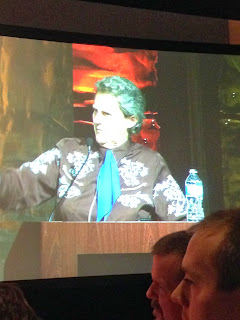
Oh, and I never mentioned that I got to meet someone I watch to every week on TV, and whose memoir I own, Orion Samuelson. I can honestly say this, and the speech given by Dr. Temple Grandin of Colorado State University were two other high points of the weekend I seem to have missed!


This organization, AFA, places students into one of four different tracks based on years in school. Within the individual tracks, different speakers and panels are brought in so that, per track, students can be connected with resources and information related to them and their current state of growth. Some of the sessions my group got to enjoy included one on time and life management, and a panel on internships, a panel on issues in agriculture and consumer education. These were all quite beneficial to my life at this point, so I really appreciated it.
AFA is an organization closely tied with industry partners. Why? The earlier students begin interacting and networking with industry professionals, the more experience they will gain with this type of interaction, and the better equipped they will be to later succeed as interns and/or employees. I will say that personally, these sorts of interactions have me on a first name basis with one of Monsanto's head recruiters, to name one example. I'm a freshman, mind you. This man has given me the opportunity to make connections with successful local people that he feels may be able to assist with my later success in life. Purdue and AFA are just two organizations which have taught me the true value of building a solid network of people from all areas of the world early on. You never know who in your network may have a connection in their own network that could forever change your life.
Much of what I have written about today has been very serious, but I must say that I have had an absolute BLAST! Those of you that follow me on Twitter ( @ebenkamp2013 ) have noticed that I learned a lot. This gave me a chance to make friends from across the country! Missouri, Arizona, New Mexico, Montana, Michigan, and Nebraska, name just a few places these great people call home. I don't know how yet, but at some point, these people may be fellow employees, clients, or a plethora of other types of connections for life.
Saturday was a busy day which we followed with a trip to the College Basketball Experience, where we had burgers, then packed 32,400 meals to be sent overseas through a company called Numana, and then we danced. I learned how to both swing and line dance. (Yes, I'm from a rural area of southern Indiana and didn't know how to swing or line dance). The power of working with a group and bonding is amazing!
Here's my "Hat's Off!" to AFA! Please check out Agriculture Future of America's webpage, Facebook, or Twitter. If it were not for them, I would never have met countless amazing people, companies, and learned skills like resume improvement and swing dancing. I hope to return next year and continue working with such phenomenal people. We can change the world. Together.
Thanks for continuing to read. Again, I know I'm pretty behind, but with homework and this conference, I know you understand.
Oh, and I never mentioned that I got to meet someone I watch to every week on TV, and whose memoir I own, Orion Samuelson. I can honestly say this, and the speech given by Dr. Temple Grandin of Colorado State University were two other high points of the weekend I seem to have missed!


Link to other 30 Days blogs here.
Day 8: Education Today - Turning from S.T.E.M. to S.T.E.A.M.
I know I am writing consistently a day behind (I wrote this and Day 9 out on paper this weekend).
Education in the 21st century is more complicated than U.S. tax code. We are also surrounded in an environment where nationally, education budgets are being slashed left and right. Every area has a different, yet similar set of issues, but I want to talk about agriculture education specifically. In this writing, I need to begin by saying I mean absolutely no disrespect to any teachers, administrators, or local legislators. I hold them all in a very high regard.
My home high school may be on the path to losing our agriculture education program. Unfortunately this has been a long time coming. Since 2009, Jasper has not had a full agriculture curriculum. When the corporation could not find a replacement teacher, we were lucky enough to at least have our previous teacher offer to teach two classes per day. This led to the further decline to a point where most of our student body is nearly unaware of the fact that we offer agriculture.
Where do we go from here? The four steps of creativity would be my place to start. Step one is looking for something new, and to begin brainstorming ways to revitalize and grow an old, dated program. Step two is incubation. In this stage, we must brew over these ideas and let them sink in. Step 3 is Illumination. This is where we have our "light bulb" moment. This often takes time and occurs in less-than-opportune times, like in the car, lying awake at night, or in the shower. Step four is the hardest; implementation. Many people will give up in step four. Never give up!! You fought to get this far!
As I continue to try working with my school's administration in order to hopefully rescue and revive this, it is my responsibility to utilize these steps to help the corporation succeed with this venture.
Back to my original point, education in America is a fragile system that politicians continue to strip. What we need is a revitalization of the education system. In Indiana specifically, we push students very hard toward S.T.E.M. careers (Science, Technology, Engineering, and Math). My school specifically is a large supporter of our engineering and health science pathways, as well as our vocational technical programs in welding, auto mechanics, and the like. What is missing here? Well (again, do not get me wrong, or be offended), it's great to have a population trained in healthcare, tech, engineering, and math, but we lose some steam in logic. Who is going to feed these people?? I want to advocate for a S.T.E.A.M. program (Science, Technology, Engineering, Agriculture, and Math). You may think, "Well, doesn't agriculture fall under EVERY SINGLE ONE of these categories?!" Yes sir/ma'am it does. Well then, why should this be changed? Everyone FORGETS about this! A few students in my home high school were asked last year and laughed when asked if they considered a future in agriculture. "I don't know anything about farming or animals!" is the common response. Well, good! You fit in with a large percentage of those now working in the agriculture world. In 2012, only 1.5-2% of people in America were actually involved in farming. The opportunities are endless.
Education and advocacy are starting points. A move from schools preaching S.T.E.M. to teaching S.T.E.A.M. would give millions more students the opportunity to succeed in a place that they never previously would have known existed. They can use any talent they have, whether it be technical, creative, or quantitative, however they wish. This is real life. This is today, and food, fiber, and fuel is the future of the world. It's up to us to keep moving forward. Where will you go??
Link up to other 30 Days bloggers here.
Education in the 21st century is more complicated than U.S. tax code. We are also surrounded in an environment where nationally, education budgets are being slashed left and right. Every area has a different, yet similar set of issues, but I want to talk about agriculture education specifically. In this writing, I need to begin by saying I mean absolutely no disrespect to any teachers, administrators, or local legislators. I hold them all in a very high regard.
My home high school may be on the path to losing our agriculture education program. Unfortunately this has been a long time coming. Since 2009, Jasper has not had a full agriculture curriculum. When the corporation could not find a replacement teacher, we were lucky enough to at least have our previous teacher offer to teach two classes per day. This led to the further decline to a point where most of our student body is nearly unaware of the fact that we offer agriculture.
Where do we go from here? The four steps of creativity would be my place to start. Step one is looking for something new, and to begin brainstorming ways to revitalize and grow an old, dated program. Step two is incubation. In this stage, we must brew over these ideas and let them sink in. Step 3 is Illumination. This is where we have our "light bulb" moment. This often takes time and occurs in less-than-opportune times, like in the car, lying awake at night, or in the shower. Step four is the hardest; implementation. Many people will give up in step four. Never give up!! You fought to get this far!
As I continue to try working with my school's administration in order to hopefully rescue and revive this, it is my responsibility to utilize these steps to help the corporation succeed with this venture.
Back to my original point, education in America is a fragile system that politicians continue to strip. What we need is a revitalization of the education system. In Indiana specifically, we push students very hard toward S.T.E.M. careers (Science, Technology, Engineering, and Math). My school specifically is a large supporter of our engineering and health science pathways, as well as our vocational technical programs in welding, auto mechanics, and the like. What is missing here? Well (again, do not get me wrong, or be offended), it's great to have a population trained in healthcare, tech, engineering, and math, but we lose some steam in logic. Who is going to feed these people?? I want to advocate for a S.T.E.A.M. program (Science, Technology, Engineering, Agriculture, and Math). You may think, "Well, doesn't agriculture fall under EVERY SINGLE ONE of these categories?!" Yes sir/ma'am it does. Well then, why should this be changed? Everyone FORGETS about this! A few students in my home high school were asked last year and laughed when asked if they considered a future in agriculture. "I don't know anything about farming or animals!" is the common response. Well, good! You fit in with a large percentage of those now working in the agriculture world. In 2012, only 1.5-2% of people in America were actually involved in farming. The opportunities are endless.
Education and advocacy are starting points. A move from schools preaching S.T.E.M. to teaching S.T.E.A.M. would give millions more students the opportunity to succeed in a place that they never previously would have known existed. They can use any talent they have, whether it be technical, creative, or quantitative, however they wish. This is real life. This is today, and food, fiber, and fuel is the future of the world. It's up to us to keep moving forward. Where will you go??
Link up to other 30 Days bloggers here.
Saturday, November 9, 2013
Day 7: Who Will Lead Agriculture into the Future?
As I write this, I am in the Sheraton Hotel and Convention Center in Kansas City, MO with Agriculture Future of America Leadership Conference. For those of you on Facebook and Twitter, look them up under Agriculture Future of America, or under the Twitter "hashtag," #AFALC13.
This conference is quickly changing my life. It is not that I am going to be living my life any differently after this conference necessarily, but there are many things to be said about this absolutely phenomenal conference and the people here. I will highlight some of the high points for me personally, and since the conference continues through Sunday, I will speak about it at least once again.
This conference works in "tracks." Freshmen participate in track 1, sophomores, track 2, juniors and some seniors, 3, and a select group of highly qualified seniors get to participate in track 4. Each track involves different types of activities. For example, today Track One got to have a morning session on building and improving our resumes, and working on the famous "elevator speech" that you give in interviews. For some of us who have not been at a job/internship opportunity fair for a while, this is a good thing to practice. Until I got to college and began meeting new people nearly every day, I never realized how important it was to be able to describe yourself in two minutes or less. Later this afternoon, all four tracks got to visit the "opportunity fair." Opportunity fairs are comparable to what you may call a job fair... except mostly for internships or entry level jobs. The agriculture community comes from far and wide, looking for the very best of the best students. Just like all of us, they want to continue moving this industry forward rapidly so that we can continue to feed this rapidly growing population. The afternoon consisted of of an etiquette luncheon to teach all of us freshmen the art of eating in a very formal setting. After this was a panel discussion with representatives from all different facets of agriculture, and the topic was consumer information. In today's day and age, more consumers are questioning the safety and story behind their food. The problem is that there is more misinformation available at their disposal, than truth.
I suggest you all check out the website, www.fooddialogues.com. Here, every week there is an online public discussion on issues that bother consumers and are on the minds of the general public. This is brought to you by the U.S. Farmer's and Rancher's Alliance.
The world is changing and so is the face of agriculture. In these fast-changing times, we must all remember. The future of American Agriculture is in our hands. That means, the future of this entire world is in our hands. Now, what are we going to do with it?
Thanks for continuing to read my blog!
Thursday, November 7, 2013
Day 6: "I'm Trying to Eat Healthy. I Should Avoid GMOs Right?"
Happy Thursday!
This conversation is being had in places throughout the world every day. So what's the deal? Well to start, GMO means Genetically Modified Organism. "Good, now what?" GMOs actually began with the patent by Exxon Oil Company for their oil eating bacteria in 1980. This was followed in 1982 by Genetech's Humulin, which is a form of human insulin produced by bacteria. The first field tests for genetically modified crops (tobacco and tomatoes) in the United States took place in 1987 and in 1992 Calgene's Favr Savr tomato was approved for commercial sale in the United States. This was soon followed by hybrid versions of common row crops like soybeans and corn that were resistant to the popular Glyphosate product, RoundUp. This opened many new doors in the science and food tech world.
Contrary to popular belief, today's Genetically Modified have allowed farmers to use fewer chemicals and to use practices like no-till farming. That is, no disc, plow, cultivator, or other piece of tillage equipment ever touches the ground. This allows for a building of the organic matter on the ground that over time will increase productivity. It also significantly decreases the amount of topsoil lost each year. The more valuable topsoil that is lost, the less productive land is, and this is only compounded over time. Contrary to popular belief, these issues still exist with flat land.
Too many times, people like Dr. Oz and other well known people and organizations will naturally push their personal agendas for what they believe, as we all do naturally. Too many times their "facts" are based in what they "think" or "feel." In the time we have been using biotech crops, there has yet to be a single case where someone has suffered illness or death due to the crops or food. So to answer my friend's question, no cutting GMO foods out of his diet will not make him healthier and or happier. It will simply lead him to spending a fortune on "organic, non-GMO" foods. I'll discuss organic and all of the the debates and transparency issues with that another day. The proof is in the putting. Humans believe what they want to believe. If you want proof, sit down and talk to both a creationist and an evolutionist and see how they differ. We see what we want to see. Don't be swayed by their scare tactics. Again I go back to, if it was dangerous to our health, would we willingly raise crops to eat or feed to animals that we will later eat, and suffer ourselves? I think not.
Here is the link to the Dr. Oz episode I mentioned earlier. Explicitly false. Notice that nobody from the agriculture industry was asked to be present to speak for the other side? Scare tactics are just that. Don't be fooled.
http://www.doctoroz.com/episode/what-food-industry-doesnt-want-you-know
Thanks for continuing to read my blog!
Tuesday, November 5, 2013
Day 5: CAFOs, PETA, HSUS, and Today's Livestock Producers
Hello Readers!
Today's topic is a unique one that I came up with after a heated few days of animal science class debates. I will open by saying that today's farmers are like those of the past, doing what they can to make sure we have a good, quality food supply that is safe and healthy. As time moves forward we have been able to improve genetics and meat quality, as well as using better feed to make the animal not only more efficient producers of meat, eggs, and milk, but also healthier animals.
Lately I have shared a few articles on Facebook and Twitter regarding the undercover videotaping of animals in primarily swine production facilities alleging abuse. If you cannot tell, I am one that stands with the farmer. This past spring, I wrote my legislators in Indiana about proposed legislation requiring that all of this "undercover footage" be regulated. I feel that if someone is being recorded, they should be aware of it. Also, there should be time constraints stating that these "videos" must be submitted to authorities within a certain time period following the alleged abuse. I know full well that not every single farmer is the perfect person, but neither are you and I. These people have dedicated their lives to animals and an industry whose main focus is the consumer and end product. This goes back to elementary economics. If I mistreat or malnourish my animals, who does that help? Nobody. It will take me longer to grow the animals, and the end product will be worth next to nothing. Keep this in mind.
There are a lot of Americans who stand quite firmly against, and will easily get very bent out of shape over what we now call CAFOs, or Concentrated Animal Feeding Operations. "A CFO is defined in Indiana as any animal feeding operation engaged in the confined feeding of at least 300 cattle, or 600 swine or sheep, or 30,000 fowl (chickens, turkeys, or other poultry). These numbers represent all animals that are old enough to be weaned from their mothers or birds of any size and are based on the maximum numbers at any one time on the farm during the year." (Purdue University Extension Service, http://www.extension.purdue.edu/extmedia/ID/cafo/ID-350%20HTML/ID-350.html).
Many people (often not from rural areas, or related to agriculture) will argue that these animals need to be free to roam and romp in the outdoors, and that housing animals prevents them from being happy. The truth behind this is that producers are doing what is best for their animals. Without going through every single industry to explain this point to those who do not raise livestock, I will explain further. There was a day when turkeys and chickens were raised on the range in a field, and pigs were raised on pasture of a sort. For the most part, producers have stopped this practice for many logical reasons. Without intentionally sounding offensive to the turkey, they are not smart animals, and they are also not well suited to protect themselves from predators. One good rain and half the turkeys will drown themselves by staring at the sky with their mouth open (slight exaggeration, but not by far), or a good lightning and thunder storm and you have a field of smothered, terrified turkeys that are not doing anybody any good. Continuing with turkeys, consider winter when (at least here) it gets pretty cold outside. The rate of growth will slow due to the inclimate weather being hard for the birds, and the opportunity for danger and loss just increases. Swine are another animal which many get upset about having confined. We do what we do for the safety and wellbeing of the animal. In most places and situations, pigs are raised in large buildings with differing numbers of pens that are designed for certain numbers of pigs. Within each pen is a self-feeder where the animals are free to indulge themselves as they feel fit, and water receptacles (that vary by building type and style) that afford the pigs a continuous clean source of water. Buildings are vented, climate controlled, and have manure storage capabilities that allow the animal to breathe clean, fresh air, and not have to be surrounded by their own mess. This lowers the health risk, and increases sanitation.
The Humane Society of the United States (commonly referred to as HSUS), and PETA (no, not People for the Eating of Tasty Animals), are big supporters of my prior statement that animals should be free to be outside and to romp and roam. This is what we call Animal Rights, versus Animal Welfare. These are two drastically different things. Animal Rights activists are people who view animals as equals to humans, believing that they should basically have all the freedoms we have. Animal Welfare Activists are those people who believe animals have certain rights such as the right to a clean and safe food and water supply, enough space to at least stand up, lay down, and turn around, and have a clean, safe environment. What I personally find humorous about some of the animal rights/welfare debates is HSUS. Your local animal shelter has so many cute puppies and kittens, I'm sure, and they are always raising money so that they can try to feed these animals, but after a certain period of time, many end up being euthanized. I urge you to look at some of the following links to catch up on the things you don't realize your tax dollars help fund. The first link shows the percent of HSUS's budget which is actually spent on the animal shelters. Mind you that this is not a per-shelter percent, but rather a per-state entire sum of shelter funding as a percent of HSUS's entire budget. Link two is a list of things many people do not know about the Humane Society, their actions, their spending, and their dealings. Link three is some information further on their inner workings and dealings which are kept under wraps. Link four is from Henderson State University. It is a PDF file that details tax-related information for the HSUS. You may find this to be more than you were prepared for, but I'm putting it out there. For an organization that loves animals, their march to end animal agriculture is sure a hard fought battle.
http://search.yahoo.com/r/_ylt=A0oG7lRTyXlSjCEABp5XNyoA;_ylu=X3oDMTEzdDlqaWlxBHNlYwNzcgRwb3MDMgRjb2xvA2FjMgR2dGlkA1NNRTM0NV8x/SIG=1396en36q/EXP=1383741907/**http%3a//www.humanewatch.org/images/uploads/VisualHSUS_AnimalShelterPercentages2010.pdf
http://www.consumerfreedom.com/2012/01/9-things-you-didnt-know-about-hsus/
http://www.humanewatch.org/unpacking_the_hsus_gravy_train_2012_edition/
http://search.yahoo.com/r/_ylt=A0oG7jvqyXlSzC0AZn9XNyoA;_ylu=X3oDMTEzb21pZG8zBHNlYwNzcgRwb3MDNgRjb2xvA2FjMgR2dGlkA1NNRTM0NV8x/SIG=12dl2opui/EXP=1383742058/**http%3a//www.hsu.edu/WorkArea/DownloadAsset.aspx%3fid=18044
America's farmers and ranchers are people like you and me, only a little different. They have dedicated their life's work to plants growing in a field, or livestock living in a field or a building. They care far more than you realize about what is going on inside those animals, as well as what will become of those animals. These people don't put everything they own on the line so they can mistreat animals and expect to get a paycheck. If you mistreat animals, you DO NOT MAKE MONEY. It's pretty black and white. These animals are obviously of some significance to the farmer/rancher, and therefore will be well taken care of.
Here is some food for thought. If you adopt a puppy from your local humane society, they will come and take it away if they find out that it is living outside. However, this is coming from the same organization that states that cattle, pigs, sheep, goats, and poultry (and any others I skipped), should be free to live outside in the wild, to roam free and to be happy. If you ask me, and if you ever look at one, an animal raised inside looks pretty happy. They are in a climate controlled environment, safe from weather extremes, have a constant buffet, as much clean water as they want, and are kept healthy. Food for thought.
I hope you enjoyed this post. I'm expecting some upset people due to my stance on animal rights activists, but I knew to expect that as I wrote.
Enjoy your day, and please continue to read on!
Today's topic is a unique one that I came up with after a heated few days of animal science class debates. I will open by saying that today's farmers are like those of the past, doing what they can to make sure we have a good, quality food supply that is safe and healthy. As time moves forward we have been able to improve genetics and meat quality, as well as using better feed to make the animal not only more efficient producers of meat, eggs, and milk, but also healthier animals.
Lately I have shared a few articles on Facebook and Twitter regarding the undercover videotaping of animals in primarily swine production facilities alleging abuse. If you cannot tell, I am one that stands with the farmer. This past spring, I wrote my legislators in Indiana about proposed legislation requiring that all of this "undercover footage" be regulated. I feel that if someone is being recorded, they should be aware of it. Also, there should be time constraints stating that these "videos" must be submitted to authorities within a certain time period following the alleged abuse. I know full well that not every single farmer is the perfect person, but neither are you and I. These people have dedicated their lives to animals and an industry whose main focus is the consumer and end product. This goes back to elementary economics. If I mistreat or malnourish my animals, who does that help? Nobody. It will take me longer to grow the animals, and the end product will be worth next to nothing. Keep this in mind.
There are a lot of Americans who stand quite firmly against, and will easily get very bent out of shape over what we now call CAFOs, or Concentrated Animal Feeding Operations. "A CFO is defined in Indiana as any animal feeding operation engaged in the confined feeding of at least 300 cattle, or 600 swine or sheep, or 30,000 fowl (chickens, turkeys, or other poultry). These numbers represent all animals that are old enough to be weaned from their mothers or birds of any size and are based on the maximum numbers at any one time on the farm during the year." (Purdue University Extension Service, http://www.extension.purdue.edu/extmedia/ID/cafo/ID-350%20HTML/ID-350.html).
Many people (often not from rural areas, or related to agriculture) will argue that these animals need to be free to roam and romp in the outdoors, and that housing animals prevents them from being happy. The truth behind this is that producers are doing what is best for their animals. Without going through every single industry to explain this point to those who do not raise livestock, I will explain further. There was a day when turkeys and chickens were raised on the range in a field, and pigs were raised on pasture of a sort. For the most part, producers have stopped this practice for many logical reasons. Without intentionally sounding offensive to the turkey, they are not smart animals, and they are also not well suited to protect themselves from predators. One good rain and half the turkeys will drown themselves by staring at the sky with their mouth open (slight exaggeration, but not by far), or a good lightning and thunder storm and you have a field of smothered, terrified turkeys that are not doing anybody any good. Continuing with turkeys, consider winter when (at least here) it gets pretty cold outside. The rate of growth will slow due to the inclimate weather being hard for the birds, and the opportunity for danger and loss just increases. Swine are another animal which many get upset about having confined. We do what we do for the safety and wellbeing of the animal. In most places and situations, pigs are raised in large buildings with differing numbers of pens that are designed for certain numbers of pigs. Within each pen is a self-feeder where the animals are free to indulge themselves as they feel fit, and water receptacles (that vary by building type and style) that afford the pigs a continuous clean source of water. Buildings are vented, climate controlled, and have manure storage capabilities that allow the animal to breathe clean, fresh air, and not have to be surrounded by their own mess. This lowers the health risk, and increases sanitation.
The Humane Society of the United States (commonly referred to as HSUS), and PETA (no, not People for the Eating of Tasty Animals), are big supporters of my prior statement that animals should be free to be outside and to romp and roam. This is what we call Animal Rights, versus Animal Welfare. These are two drastically different things. Animal Rights activists are people who view animals as equals to humans, believing that they should basically have all the freedoms we have. Animal Welfare Activists are those people who believe animals have certain rights such as the right to a clean and safe food and water supply, enough space to at least stand up, lay down, and turn around, and have a clean, safe environment. What I personally find humorous about some of the animal rights/welfare debates is HSUS. Your local animal shelter has so many cute puppies and kittens, I'm sure, and they are always raising money so that they can try to feed these animals, but after a certain period of time, many end up being euthanized. I urge you to look at some of the following links to catch up on the things you don't realize your tax dollars help fund. The first link shows the percent of HSUS's budget which is actually spent on the animal shelters. Mind you that this is not a per-shelter percent, but rather a per-state entire sum of shelter funding as a percent of HSUS's entire budget. Link two is a list of things many people do not know about the Humane Society, their actions, their spending, and their dealings. Link three is some information further on their inner workings and dealings which are kept under wraps. Link four is from Henderson State University. It is a PDF file that details tax-related information for the HSUS. You may find this to be more than you were prepared for, but I'm putting it out there. For an organization that loves animals, their march to end animal agriculture is sure a hard fought battle.
http://search.yahoo.com/r/_ylt=A0oG7lRTyXlSjCEABp5XNyoA;_ylu=X3oDMTEzdDlqaWlxBHNlYwNzcgRwb3MDMgRjb2xvA2FjMgR2dGlkA1NNRTM0NV8x/SIG=1396en36q/EXP=1383741907/**http%3a//www.humanewatch.org/images/uploads/VisualHSUS_AnimalShelterPercentages2010.pdf
http://www.consumerfreedom.com/2012/01/9-things-you-didnt-know-about-hsus/
http://www.humanewatch.org/unpacking_the_hsus_gravy_train_2012_edition/
http://search.yahoo.com/r/_ylt=A0oG7jvqyXlSzC0AZn9XNyoA;_ylu=X3oDMTEzb21pZG8zBHNlYwNzcgRwb3MDNgRjb2xvA2FjMgR2dGlkA1NNRTM0NV8x/SIG=12dl2opui/EXP=1383742058/**http%3a//www.hsu.edu/WorkArea/DownloadAsset.aspx%3fid=18044
America's farmers and ranchers are people like you and me, only a little different. They have dedicated their life's work to plants growing in a field, or livestock living in a field or a building. They care far more than you realize about what is going on inside those animals, as well as what will become of those animals. These people don't put everything they own on the line so they can mistreat animals and expect to get a paycheck. If you mistreat animals, you DO NOT MAKE MONEY. It's pretty black and white. These animals are obviously of some significance to the farmer/rancher, and therefore will be well taken care of.
Here is some food for thought. If you adopt a puppy from your local humane society, they will come and take it away if they find out that it is living outside. However, this is coming from the same organization that states that cattle, pigs, sheep, goats, and poultry (and any others I skipped), should be free to live outside in the wild, to roam free and to be happy. If you ask me, and if you ever look at one, an animal raised inside looks pretty happy. They are in a climate controlled environment, safe from weather extremes, have a constant buffet, as much clean water as they want, and are kept healthy. Food for thought.
I hope you enjoyed this post. I'm expecting some upset people due to my stance on animal rights activists, but I knew to expect that as I wrote.
Enjoy your day, and please continue to read on!
Subscribe to:
Posts (Atom)